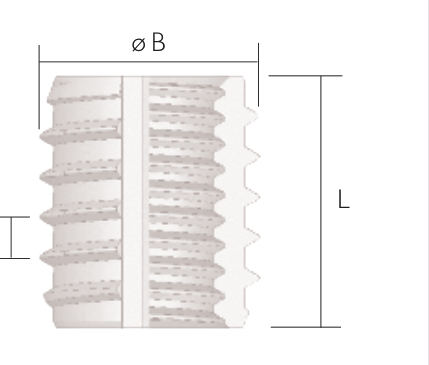
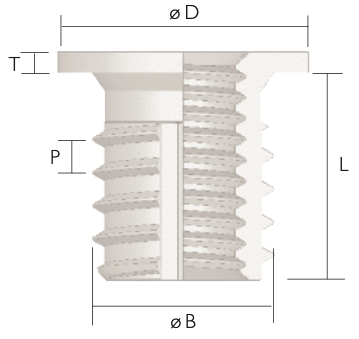
The self-tapping insert carries a sharp external cutting thread interrupted by three equidistant longitudinal flutes. As it is driven into a pilot hole, the flutes shear a clean mating thread in the surrounding plastic and channel the displaced material away — much like a tap. No heat or ultrasonic energy is required, so installation needs only a screwdriver or simple insertion spindle.
Because the insert cuts rather than melts, installation torque rises predictably to a defined seating value; monitoring this torque confirms full thread engagement on the production line. The internal thread (d) is cut to ISO 6H tolerance and the body length (L) sets the depth of engagement. Headed, reduced-head, regular-head and double-ended variants suit flush, recessed or through-fix applications.
Self-tapping inserts are the preferred choice for harder engineering thermoplastics (ABS, Nylon, PC, glass-filled grades) and for field service where heat-set tooling is unavailable.
| Thread | Pitch (mm) | External Ø (B) | Length L (mm) | Rec. hole Ø | Min boss Ø | Min wall |
|---|---|---|---|---|---|---|
| M2 | 0.40 | 3.50 | 4.0 – 4.8 | 3.1 – 3.3 | 5.8 | 1.25 |
| M2.5 | 0.45 | 4.33 | 4.0 – 6.25 | 3.8 – 4.1 | 7.2 | 1.55 |
| M3 | 0.50 | 4.73 | 4.0 – 6.25 | 4.1 – 4.4 | 7.7 | 1.65 |
| M3.5 | 0.60 | 5.52 | 5.0 – 7.3 | 5.0 – 5.3 | 9.3 | 2.00 |
| M4 | 0.70 | 6.31 | 5.6 – 8.4 | 5.8 – 6.1 | 10.7 | 2.30 |
| M5 | 0.80 | 7.50 | 6.4 – 10.0 | 6.9 – 7.2 | 12.6 | 2.70 |
| M6 | 1.00 | 8.69 | 7.9 – 12.0 | 8.0 – 8.4 | 14.7 | 3.15 |
| M8 | 1.25 | 11.06 | 9.5 – 12.4 | 10.1 – 10.6 | 18.6 | 4.00 |
| M10 | 1.50 | 13.95 | 12.0 – 16.0 | 13.0 – 13.5 | 23.7 | 5.10 |
Dimensions per the Tappex Trisert® self-tapping range. B = external thread diameter; L spans the short/regular/long length options. Recommended hole diameter is for thermoplastics; confirm against substrate and drawing at quotation. Reduced-head and double-ended variants available across the range.
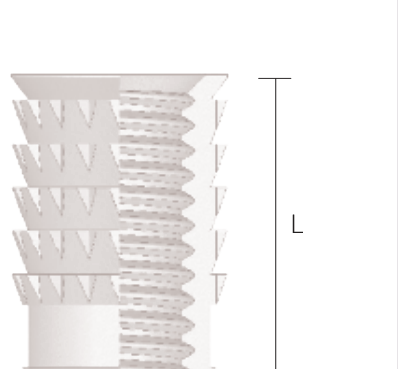
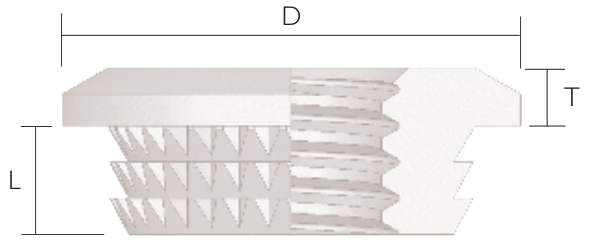
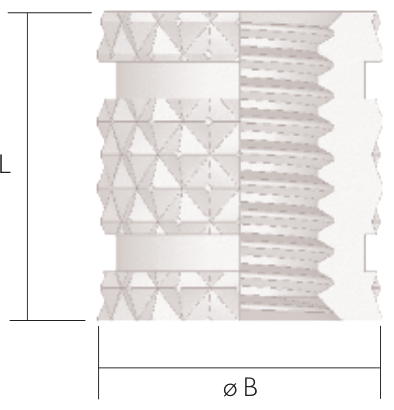
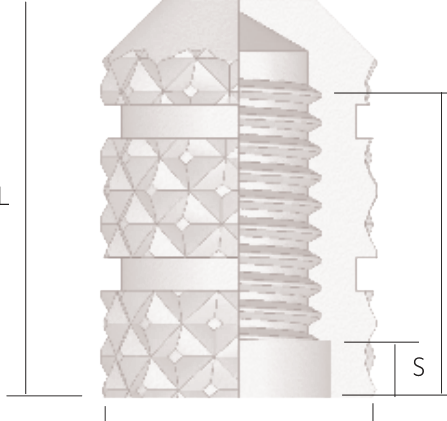
The barbed press-in insert has an external profile of opposed barbs and a diamond knurl that resist both pull-out (axial) and spin-out (torque). The same part can be installed three ways: pressed cold into a pre-moulded hole, set with a heated tip, or driven by an ultrasonic horn. With heat or ultrasonic energy the surrounding plastic softens, flows into the barbs and knurl, and re-solidifies to lock the insert permanently — the highest-performing method.
Key dimensions are the internal thread (d), the head/flange diameter (D) where fitted, overall length (L) and the recommended hole diameter. A square lead-in chamfer at each end aids automatic feeding and starts the insert straight. Unheaded, single-head, double-head and thin-section "Microbarb" variants cover flush, blind and tight-pitch boss layouts.
Barbed press-in inserts suit softer thermoplastics, foamed grades and over-moulded assemblies, and are the standard choice for high-volume heat-set lines in consumer electronics, automotive trim and enclosures.
| Thread | Pitch (mm) | Length L (mm) | Rec. hole Ø | Min boss Ø | Min wall |
|---|---|---|---|---|---|
| M1.6 | 0.35 | 3.2 | 2.3 – 2.5 | 4.5 | 1.00 |
| M2 | 0.40 | 3.1 – 4.8 | 3.0 – 3.3 | 6.0 | 1.35 |
| M2.5 | 0.45 | 4.1 – 5.2 | 3.7 – 4.0 | 7.4 | 1.70 |
| M3 | 0.50 | 4.1 – 5.2 | 3.7 – 4.0 | 7.4 | 1.70 |
| M3.5 | 0.60 | 4.1 – 7.0 | 4.6 – 5.0 | 9.5 | 2.25 |
| M4 | 0.70 | 5.6 – 8.5 | 5.4 – 5.9 | 10.9 | 2.50 |
| M5 | 0.80 | 6.6 – 10.1 | 6.0 – 6.5 | 12.2 | 2.85 |
| M6 | 1.00 | 7.7 – 12.3 | 7.7 – 8.2 | 14.6 | 3.20 |
| M8 | 1.25 | 8.3 – 13.8 | 10.2 – 10.6 | 19.1 | 4.25 |
| M10 | 1.50 | 10.5 – 16.1 | 12.5 – 13.0 | 23.2 | 5.10 |
| M12 | 1.75 | 16.1 | 15.0 – 15.4 | 25.8 | 5.20 |
Dimensions per the Tappex Multisert® barbed press-in range (unheaded / single- & double-thickness head variants). L spans short and regular lengths. Recommended hole diameter is for cold press / heat-set in thermoplastics; open up slightly for glass-filled grades. Microbarb® thin-section variants available for tight boss walls.
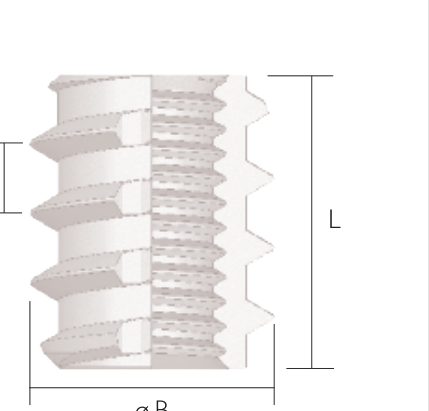
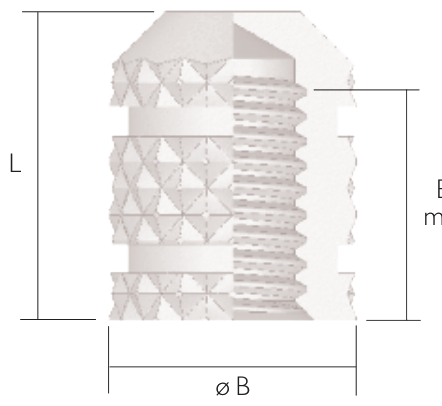
Foam-grade inserts use a coarse, truncated external thread with a pitch up to 2.5 times that of a standard insert. The deep, widely-spaced flights capture a large volume of substrate between turns, spreading load over a big surface and dramatically increasing pull-out strength in soft, low-density materials where a fine thread would simply strip or pull through.
They are designed for structural foam mouldings, MDF, chipboard, particleboard and laminated panels — common in furniture, point-of-sale fixtures, loudspeaker enclosures and lightweight composite cores. The insert is screwed in (or moulded in) and provides a clean ISO 6H metal thread (d) for repeated assembly and disassembly. Headed and double-ended variants distribute clamp load and allow through-panel fixing.
Where the substrate is extremely friable, foam-grade inserts can be combined with a bonding adhesive for permanent retention.
| Thread | Coarse ext. pitch | External Ø (B) | Length L (mm) | Rec. hole Ø | Min boss Ø | Min wall |
|---|---|---|---|---|---|---|
| M2.5 | 1.81 | 5.50 | 8.0 | 4.25 – 5.00 | 12.50 | 3.75 |
| M3 | 1.81 | 5.50 | 8.0 – 9.0 | 4.25 – 5.00 | 12.50 | 3.75 |
| M3.5 | 2.12 | 6.30 | 8.5 | 5.00 – 5.75 | 14.40 | 4.33 |
| M4 | 2.31 | 7.10 | 9.0 – 11.0 | 5.70 – 6.50 | 16.30 | 4.90 |
| M5 | 2.54 | 8.70 | 10.0 – 12.0 | 7.20 – 8.10 | 20.30 | 6.10 |
| M6 | 2.82 | 10.00 | 12.0 – 16.0 | 8.40 – 9.30 | 23.30 | 7.00 |
| M8 | 3.63 | 12.00 | 16.0 – 20.0 | 10.40 – 11.30 | 28.30 | 8.50 |
Dimensions per the Tappex Foamsert® range. Note the coarse truncated external pitch (e.g. 1.81 mm at M2.5) versus a standard self-tapping insert — this is what grips low-density foam, MDF and chipboard. L spans double-ended and reduced-headed length options. Recommended hole diameter depends on substrate density; confirm against drawing at quotation.
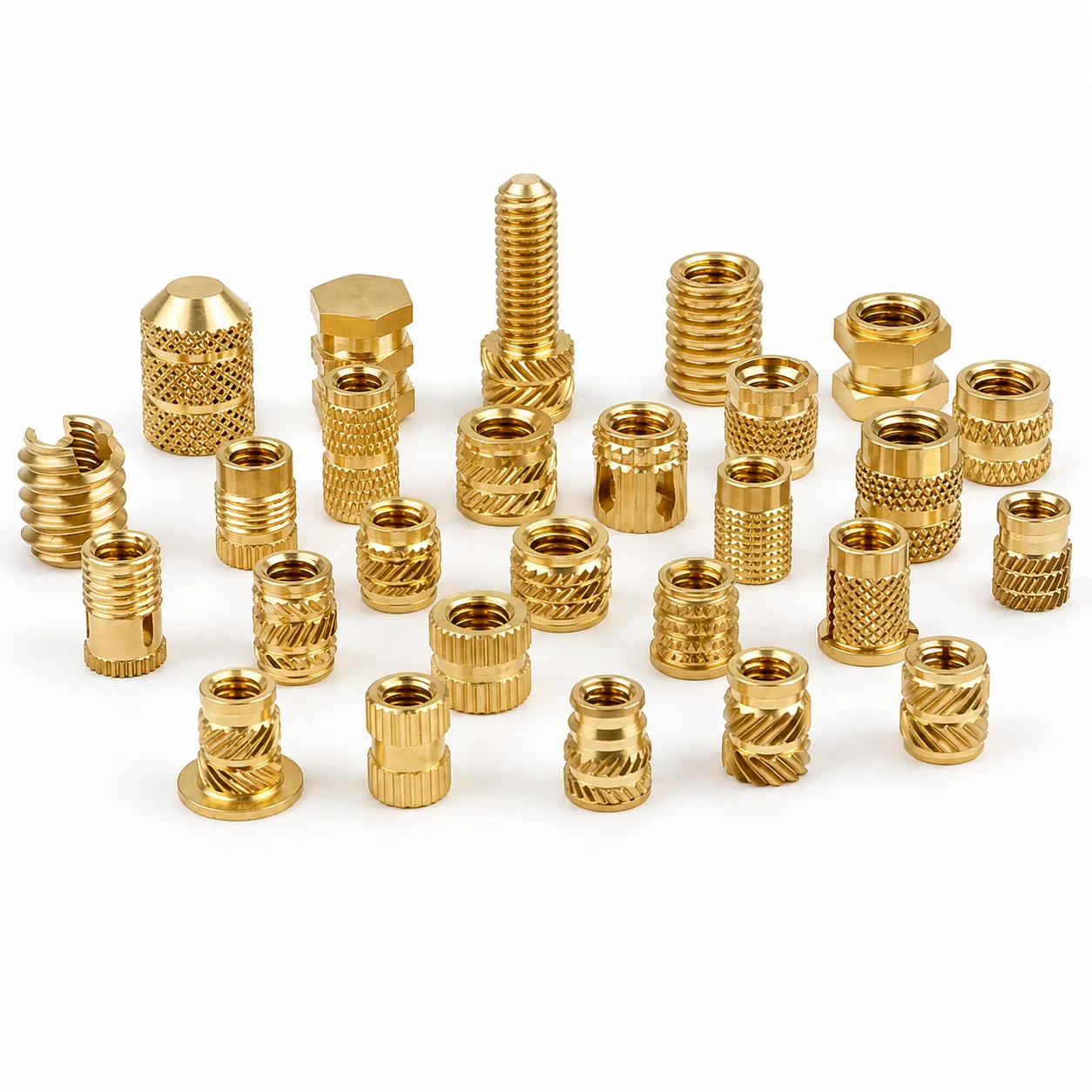
Each insert family is produced in a full set of head, length and body configurations to suit flush, recessed, blind and through-fix layouts — and Brassland routinely manufactures every variant shown below in CW614N brass. Beyond the standard range, we make fully bespoke inserts to your drawing: any thread, length, knurl or barb profile, head form, alloy or plating.


Non-standard thread sizes, special lengths, bespoke knurl or barb profiles, unique head forms, UNC/UNF threads, alternative alloys and platings — if you can draw it, we can turn it. Send a PDF or dimensioned sketch and we will quote within 24 hours from Jamnagar.
Brassland does not hold stock. All self-tapping, press-in and foam-grade inserts are machined and knurled to order from CW614N brass bar in our Jamnagar facility. This means every batch is fresh, fully traceable from bar to finished part, and can be supplied to your exact thread size, length and quantity without compromise on quality.
Heat-set and barbed press-in inserts give moulded plastic housings a durable, reusable metal thread for screw-fixed covers, PCB standoffs, battery doors and connector panels. The brass insert survives repeated opening that would strip a self-tapping screw straight into plastic. Electronics components →
Self-tapping and press-in inserts anchor trim, brackets, sensor housings and under-bonnet mouldings. Their high pull-out and anti-spin knurl resist vibration and thermal cycling, making them a standard fastening for engineering-plastic and composite components. Automotive components →
Foam-grade inserts provide strong, demountable threads in MDF, chipboard, structural foam and laminated panels — used in flat-pack furniture, point-of-sale fixtures, loudspeaker cabinets and lightweight composite cores where conventional inserts pull through.
Self-tapping inserts have an external cutting thread and tap their own thread into the plastic — installed cold, no heat. Barbed press-in inserts have a barbed, knurled body and are pressed, heat-set or ultrasonically installed so the substrate flows around the profile for maximum pull-out. Foam-grade inserts use a coarse truncated thread (up to 2.5× standard pitch) to grip soft substrates such as structural foam, MDF and chipboard without pulling through.
Not always. Self-tapping inserts install cold — simply driven in with a screwdriver or insertion tool. Barbed press-in inserts can be pressed cold, or set with heat / ultrasonic for the highest pull-out. Heat-set inserts are designed specifically for a heated press tip or ultrasonic welder, where molten plastic flows into the knurl and re-solidifies to lock the insert.
Self-tapping: M2–M10. Barbed press-in: M1.6–M12. Foam-grade: M2.5–M8. Heat-set and moulding inserts: M2–M12. Internal threads are cut to ISO 6H tolerance. Non-standard threads, lengths and unified (UNC/UNF) forms are available on request.
Yes. CW614N brass contains ~3% lead which is explicitly exempted under RoHS Annex III entry 6(c) (valid to 30 June 2027). REACH Article 33 SVHC disclosures are supplied with each order. Mill test certificates per EN 10204 Type 3.1 are standard; Type 3.2 (third-party witness) is available on request.
All Brassland inserts are machined to order from CW614N bar stock in Jamnagar — there is no pre-held inventory, which ensures every batch is fully traceable. Standard types ship in 2–3 weeks from order confirmation. There is no formal MOQ: small development quantities are accepted. Custom thread forms, profiles or alloys are equally welcome — send a PDF drawing to info [at] brassland [dot] com for a quotation within 24 hours.
Brassland manufactures to the published EN, ISO and ASTM specifications below. Mill certificates per EN 10204 Type 3.1 are supplied as standard; Type 3.2 (third-party witnessed) available on request. Open any link to verify the standard directly with the publishing body.
Last reviewed: May 2026. All Brassland products are made to order — please confirm grade, surface finish, plating and packaging requirements at quotation stage. Standards listed above are referenced; production lots are released against the EN 10204 Type 3.1 inspection certificate accompanying each shipment.