Process Guide 01

CNC Turning & Milling
Brass · Copper · Aluminium

Multi-axis turning, turn-mill and rotary-transfer machining of brass, copper and aluminium — finished complete, held to tight tolerances, and made to order in Jamnagar, India.

79+ CNC machines Turn-mill · Y-axis · sub-spindle ISO 9001 / 14001 / 45001
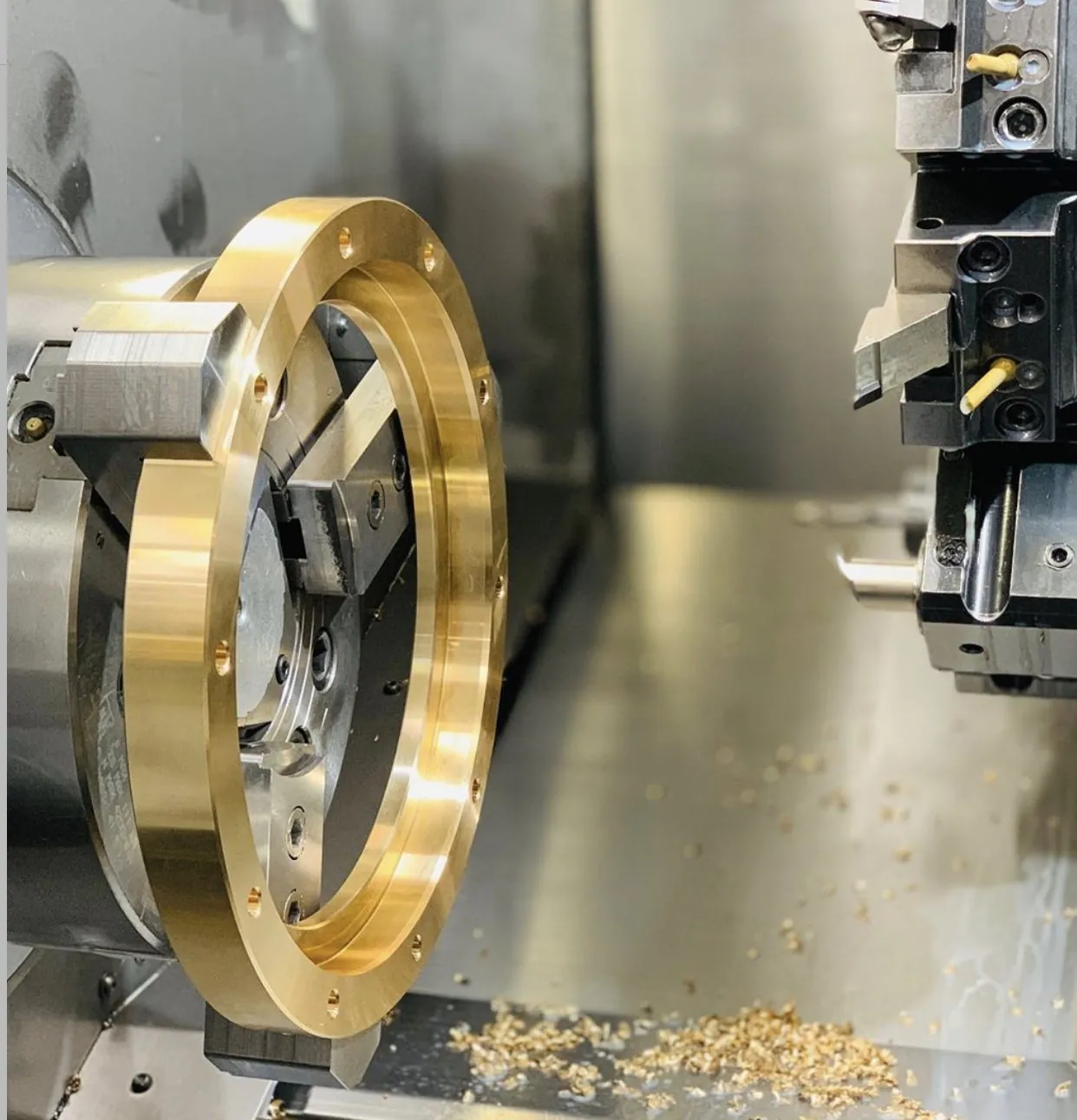
Large brass bearing ring being precision-turned on a multi-axis CNC lathe at Brassland, with brass chips visible — CNC machining of brass
In-House Machine Fleet

The Machines Behind Your Parts

79+
CNC machines under one roof
65+
CNC turning centres
11
Turn-mill centres — sub-spindle & Y-axis
03
Rotary-transfer machines — 8 stations

Every component is turned, milled and finished on our own machines in Jamnagar — machining is never subcontracted. The mix of turning centres, multi-axis turn-mill centres and 8-station rotary-transfer machines lets us match the right process to your part — from low-volume prototypes to millions of pieces a year.

Materials We Machine

Brass, Copper & Aluminium

Brass

CW617N, CW614N, CW602N (DZR), CW724R (lead-free) and CW510L — from free-machining grades to dezincification-resistant and drinking-water alloys.

Alloy datasheets →
Copper

C11000 (ETP) — high electrical and thermal conductivity for contacts, terminals and busbar hardware.

C11000 datasheet →
Aluminium

6061 & 6063 — lightweight structural, enclosure and heat-dissipating parts where weight and corrosion resistance matter.

Aluminium & copper →
Done-in-One Machining

Complete Parts in a Single Setup

Turn-mill centres with driven tooling, Y-axis and sub-spindle — backed by 8-station rotary-transfer machines — finish complex parts in one operation. Fewer setups mean tighter concentricity, lower cost and faster delivery.

OD & ID turning Cross-drilling & tapping Transverse & face milling Slots, flats & hexes Thread milling Knurling Back-working on sub-spindle In-line deburring
Quality & Assurance

Why OEMs Choose Brassland

  • ✓  ISO 9001, ISO 14001 & ISO 45001 — certified by DQS
  • ✓  First-article inspection (FAI) before every production run
  • ✓  In-process dimensional checks on every shift
  • ✓  Full traceability — EN 10204 3.1 mill certificates on request
  • ✓  Consistent, repeatable quality lot-to-lot — not import variability
  • ✓  English-speaking engineering team; exports to 40+ countries
Send your drawing.

We review your 2D/3D part and quote within 24 hours — in the right alloy, on the right machine.

Request a Quote →
Machined Components

Parts We Turn & Mill

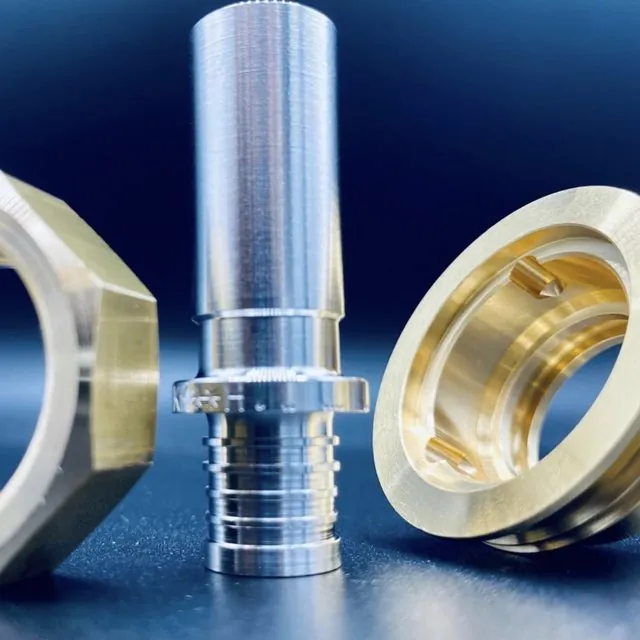
A sample of precision brass, copper and aluminium components produced on our CNC turning, turn-mill and rotary-transfer machines.

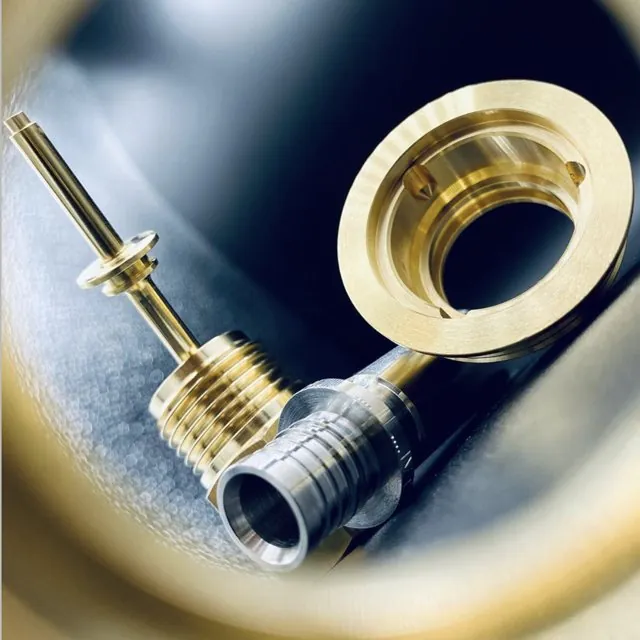
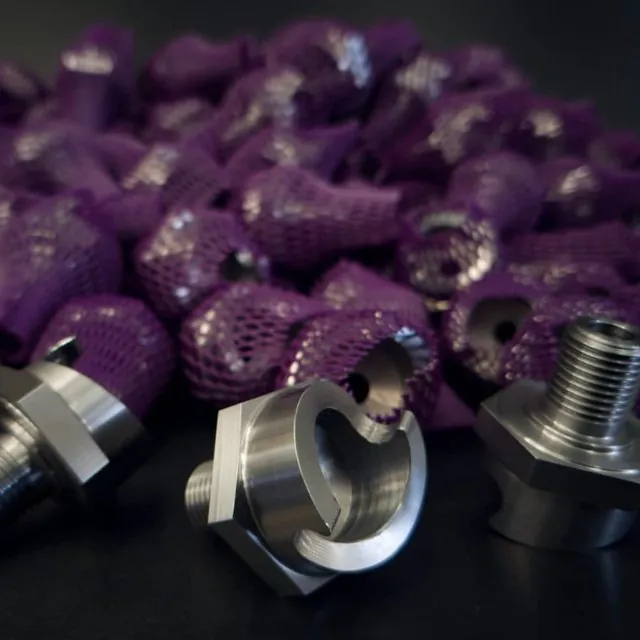
Machined brass and nickel-plated hose fittings and nut
Brass valve component being precision-turned on a lathe
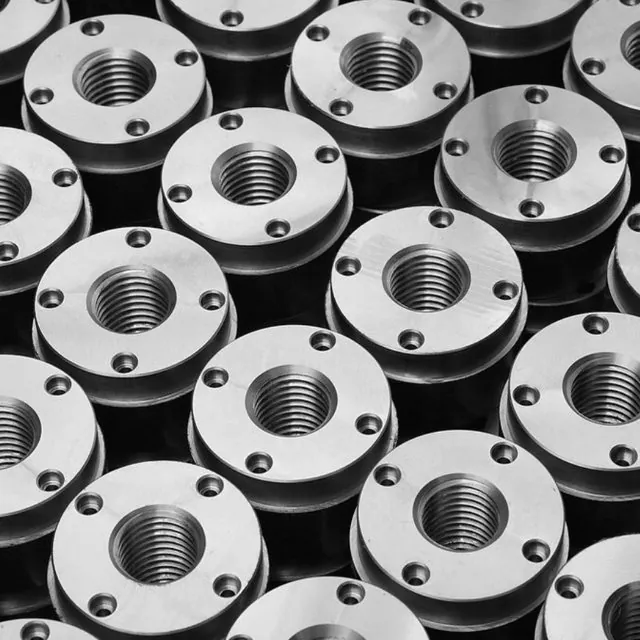
Rows of machined flanged nuts with threaded bores
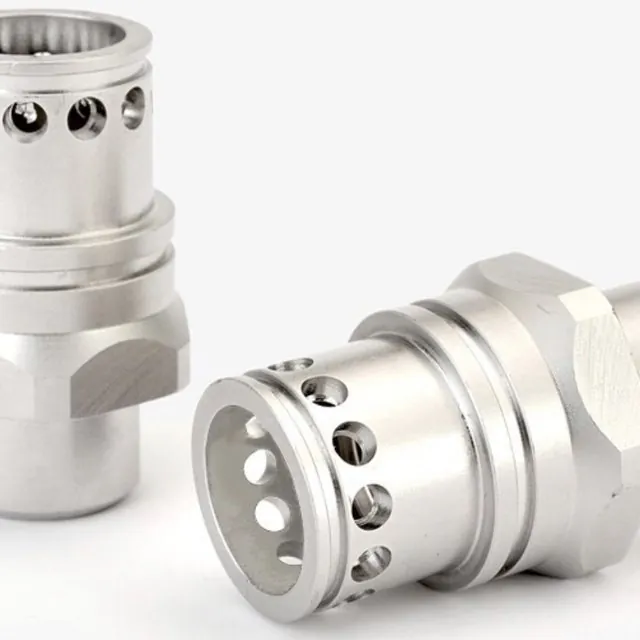
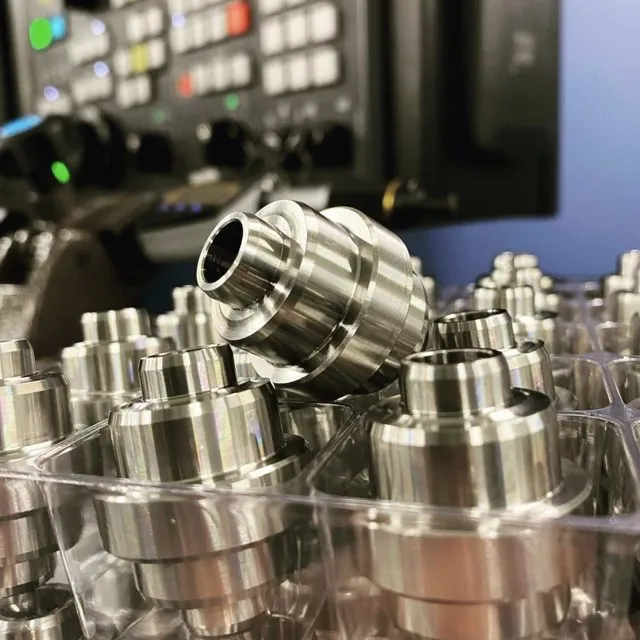
CNC machined stainless steel quick-connect coupling
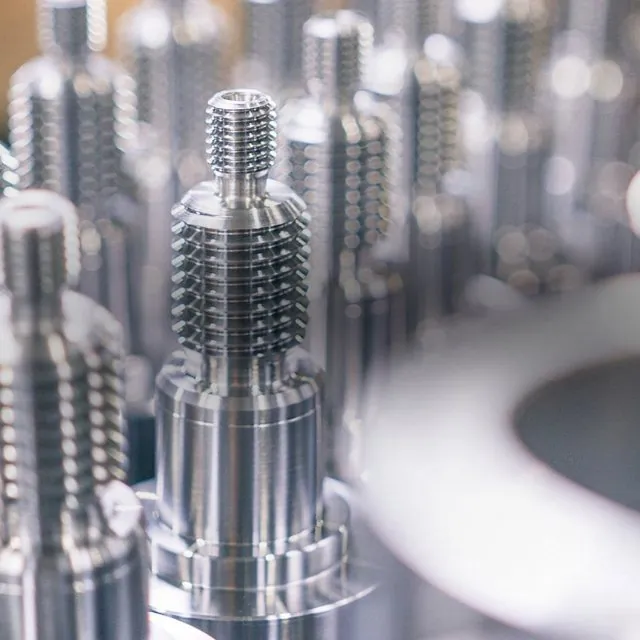
Batch of CNC turned threaded steel shafts
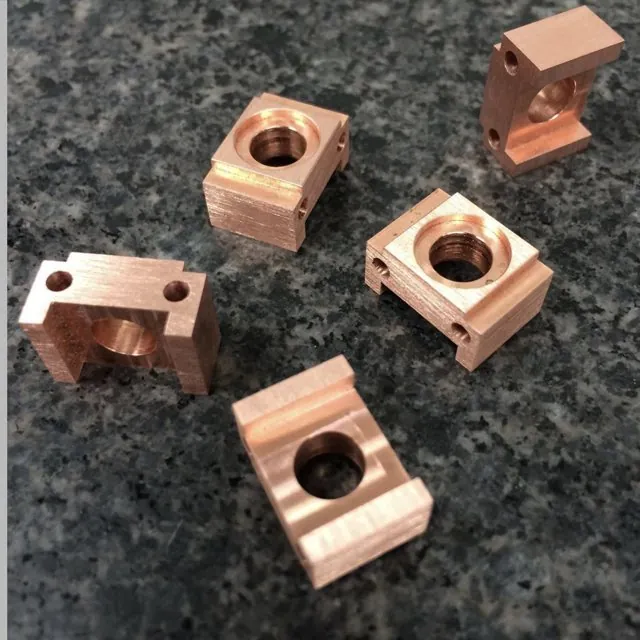
Machined copper terminal blocks
Coated knurled threaded inserts produced in volume
Flanged metal components being machined on a CNC centre
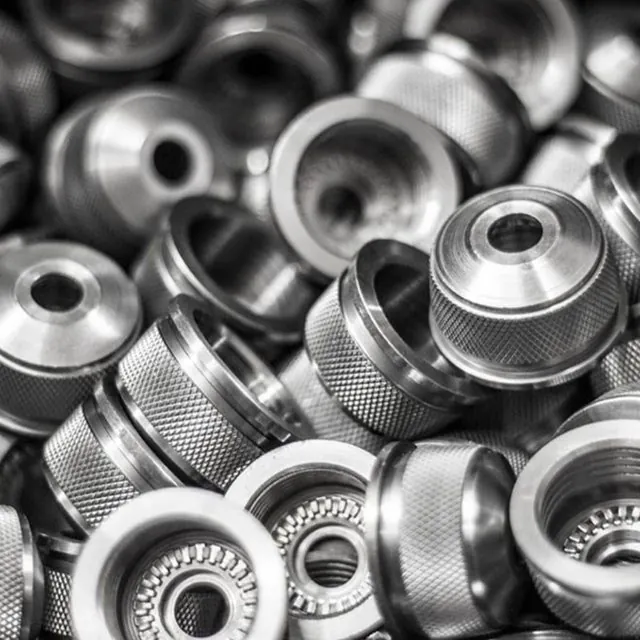
Rows of CNC knurled stainless bushes
Why Brass is the Easiest Metal to Machine
400
m/min max cutting speed (CW617N)
100%
machinability reference (vs steel)
faster than 316 stainless steel
Dry
machining possible for leaded grades

Leaded brass (CW617N, CW614N) machines faster than any other structural metal. Lead at 1.6–3.5% acts as an internal lubricant and chip breaker, enabling very high cutting speeds, excellent surface finish, and long tool life without coolant. This is why Jamnagar produces hundreds of millions of brass fittings per year.

Cutting Parameters

CNC Turning Parameters — All Key Alloys

AlloyMachinabilityVc (m/min)Feed (mm/rev)Rake AngleCoolantChip Form
CW617N 100% 200 – 400 0.10 – 0.30 0° to +5° Dry OK Short, brittle chips
CW614N 95% 190 – 380 0.08 – 0.28 0° to +5° Dry OK Short, very fine chips
CW625N 72% 150 – 300 0.08 – 0.25 +3° to +8° Recommended Moderate length chips
CW612N 65% 130 – 280 0.08 – 0.22 +5° to +10° Recommended Moderate, longer chips
CW607N 65% 130 – 280 0.08 – 0.22 +5° to +10° Recommended Moderate chips
CW602N 62% 120 – 250 0.08 – 0.20 +5° to +10° Recommended Moderate chips
CW724R 80% 160 – 320 0.08 – 0.22 +5° to +10° Required Moderate chips, some stringiness
C27450 55% 110 – 230 0.06 – 0.18 +8° to +12° Required Longer chips, chip breaker geometry
C11000 ~20% 80 – 180 0.05 – 0.12 +10° to +15° Flood required Long, gummy, stringy chips
Tool Geometry

Insert Selection for Brass

Brass machining uses different tool geometry than steel or aluminium. Key considerations:

Insert gradeUncoated carbide (K-type)
Rake angle (leaded)0° to +5°
Rake angle (lead-free)+5° to +15°
Clearance angle6° to 12°
Nose radius (finish)0.4 – 0.8 mm
Cutting edgeSharp — no honed edge
No edge hone: Unlike steel machining where a small edge hone improves tool life, brass machining requires sharp cutting edges. A honed edge causes smearing and poor finish on brass.
Coolant Strategy

When and What to Use

Coolant requirements vary significantly by alloy — one of the key hidden costs in switching from leaded to lead-free grades:

CW617N / CW614NDry machining OK
CW625N / CW612NLight mist / emulsion
CW724R (lead-free)Flood coolant required
C11000 (copper)Heavy flood coolant
Lead-free transition cost: Switching from CW617N to CW724R adds coolant system cost (pump, recycling, disposal) plus reduced cutting speed. Account for this in total cost of ownership.
Achievable Tolerances

CNC Brass Machining — Tolerance Guide

FeatureStandard CNCPrecision CNCSwiss TurnNotes
Turned OD±0.05 mm (IT8)±0.02 mm (IT6)±0.005 mm (IT4)Diameter up to 50mm standard; tighter with temperature control
Bored ID±0.05 mm±0.02 mm±0.008 mmFine boring head or CBN tool for tight IDs
Thread (external)6g class6g/6h class6h classBrass threads cut cleanly; form tapping possible
Thread (internal)6H class6H class6H classSingle-point threading preferred for precision
Surface finish (Ra)1.6 – 3.2 μm0.8 – 1.6 μm0.4 – 0.8 μmCW614N achieves finest finish due to highest Pb content
Hex / form milled±0.10 mm±0.05 mmN/A (bar stock only)Mill after turning; milling parameters similar to turning
C11000 Machining

Copper is Different

Pure copper (C11000) is notoriously difficult to machine — it's gummy, work-hardens, and produces long stringy chips that wrap around tooling. Machinability is only ~20% vs CW617N.

Key adjustments for C11000: High positive rake (+10 to +15°), sharp inserts, flood coolant, slow feeds (0.05–0.12 mm/rev), Vc 80–180 m/min. Avoid build-up edge — use diamond (PCD) inserts for production runs.
Lead-Free Alloys

CW724R Machining

CW724R at 80% machinability produces longer, more stringy chips than leaded grades. Chip control is essential in automated machining cells.

Use chip-breaking insert geometry (positive rake +5 to +10°), ensure adequate coolant flow, and reduce depth-of-cut on the finish pass. Tool life is approximately 60–70% of CW617N at equivalent parameters.
Quality Control

In-Process Gauging

Brass exhibits low springback and minimal thermal distortion — dimensional stability after machining is excellent. In-process gauging is straightforward and SPC control charts for Cpk >1.67 are routinely achieved on CNC brass lines.

Allow parts to cool to 20°C before gauging — brass has a thermal expansion coefficient of ~18 μm/(m·K), significant at tight tolerances.
CNC Brass Components

Precision machined. Fully documented.

Brassland's CNC capacity in Jamnagar handles runs from 1,000 to 5 million parts per year with EN 10204 3.1 material certification and full inspection records — most of it custom parts machined to your drawing.

Get a Quote Custom Parts →
← Back to
Manufacturing Hub
All 3 processes
Next →
Swiss Turning
Small diameter, high precision
Production Engineering

Inside the Production Floor

Speeds and feeds are only the starting point. Holding quality and cost across runs of 50,000+ parts is what production engineering really means — here is how we run the CNC floor.

Tool-wear control

Spindle-load monitoring flags a chipped or worn insert and stops the machine, backed by scheduled insert changes on tight-tolerance work — keeping long runs inside the ±0.01 mm band.

Swarf & coolant

Low-rake insert geometry and 20–40 bar through-tool coolant clear brass chips cleanly; swarf is reclaimed at >99.5% and briquetted for recycling.

Night shifts, supervised

Production runs across day and night shifts, with quality engineers on the floor checking parts throughout every shift — so consistency holds around the clock.

MES traceability

Every run is logged in our MES — machine, operator, programme, tool and raw-material lot — and retained for 10 years, the basis of every PPAP and FAI pack for OEM customers.

Frequently Asked Questions

CNC machining at Brassland — common questions

What CNC machining capacity does Brassland have?

Brassland runs 79+ CNC machines, including 28+ Swiss-type sliding-head lathes, at its Jamnagar facility, with production across day and night shifts and quality engineers on the floor every shift. The plant is ISO 9001, 14001 and 45001 certified and exports to 40+ countries.

What tolerances can Brassland hold on CNC turned brass parts?

Typical production tolerance on turned brass diameters is ±0.01 mm, with tighter bands achievable on specific features after first-article validation. Tolerance capability depends on the process and geometry — see the tolerances guide, and send your drawing for a feature-by-feature confirmation.

Which materials do you machine?

Free-machining and lead-free brasses (CW614N, CW617N, CW602N DZR, CW724R, C6802), pure copper (C11000) and aluminium alloys. Cutting parameters are adjusted per grade — roughly 20–30% slower for lead-free silicon brass and up to 70% slower for pure copper versus leaded brass.

What volumes and documentation do you support?

Bar-fed CNC suits runs from a few thousand to millions of parts. Every run is logged in our MES — machine, operator, programme, tool and raw-material lot — retained for 10 years, supporting PPAP and FAI packs, with EN 10204 Type 3.1 mill certificates supplied as standard.
Sources & References

Verified manufacturing references

Process parameters, tolerances and tooling guidance on this page are drawn from the publishing bodies and tool manufacturers below. For production-critical specification, validate the parameters against your machine, tooling vendor and material supplier — the values shown are starting points typical of free-machining brass under standard CNC and forging conditions.

CDA — High Speed Machining of Brass
Copper Development Association benchmark study (PDF)
European Copper Institute
Wrought copper alloys — manufacturing properties
Sandvik Coromant — ISO N (non-ferrous)
Tooling parameters for brass / copper / aluminium
Iscar — Brass Turning Inserts
Insert geometry & cutting data for free-machining brass
CEN — EN 12164 / 12165 / 12420
Rod, forging stock, and forging dimensional tolerances
ISO 2768 — General Tolerances
Linear & angular tolerance classes for machined parts
ISO 1101 — GD&T
Geometrical product specification (GPS)
ISO 4287 — Surface Texture
Ra, Rz, surface roughness profile parameters
ISO 9001:2015
Quality management system — Brassland certified
IATF 16949
Automotive QMS reference standard
Brassland — Alloy Datasheets
Per-alloy machining parameters & properties
Brassland — Standards Guide
EN, ISO and ASTM standards explainer

Last reviewed: May 2026. The parameters here are typical starting values for free-machining leaded brass (CW617N/CW614N reference); reduce cutting speed and feed by ~20–30% for lead-free silicon brass (CW724R/C6802) and by ~70% for pure copper (C11000). For close-tolerance or thin-wall geometries, validate via first-article inspection (FAI) before scale production.